
There's $27.6 billion in PE deals happening across MENA, but almost none of it is touching sub-$10M service businesses. These businesses trade at 4-6x EBITDA. In the US, you'd pay 12x for the same thing.
That pricing gap existed for good reason. Service businesses were a nightmare to aggregate. You'd buy three tutoring centers and find out each one ran completely differently based on whoever happened to be the best employee there. Try to standardize, and quality collapsed. Margins got worse, not better.
PE funds learned to avoid service businesses unless they could make money purely through financial engineering. The operations were too messy.
Something broke in the last 18 months. Service businesses in MENA just became aggregable, and most PE funds haven't noticed yet.
Why Service Businesses Never Scaled
Your best customer service rep knows exactly how to read a frustrated client email. She spots the real issue underneath the complaint, addresses it before the client even articulates it, and turns a cancellation risk into a retention win. That skill lives entirely in her head.
When she quits, it walks out the door with her.
You can't train three new hires to replicate that judgment. They'll learn eventually, maybe, but it takes years of pattern recognition that's impossible to document in a training manual. Service businesses scale by hiring more people and hoping some of them turn out well.
Traditional software tried fixing this with rules engines. Spent millions building decision trees on Hubspot, Salesforce, and the like. If customer mentions price, route to retention team. If they mention competitor, escalate to manager. The moment reality diverged from the script, the whole system failed. Nobody called following a script. They asked messy questions that didn't fit the flowchart.
Service businesses stayed labor-intensive because the knowledge transfer problem was unsolvable.comparable businesses in the US and Europe. That's the first layer of the arbitrage
What Changed
AI systems can now execute complete workflows with judgment. Not chatbots that answer scripted questions. Systems that handle the entire process from inquiry to resolution autonomously.
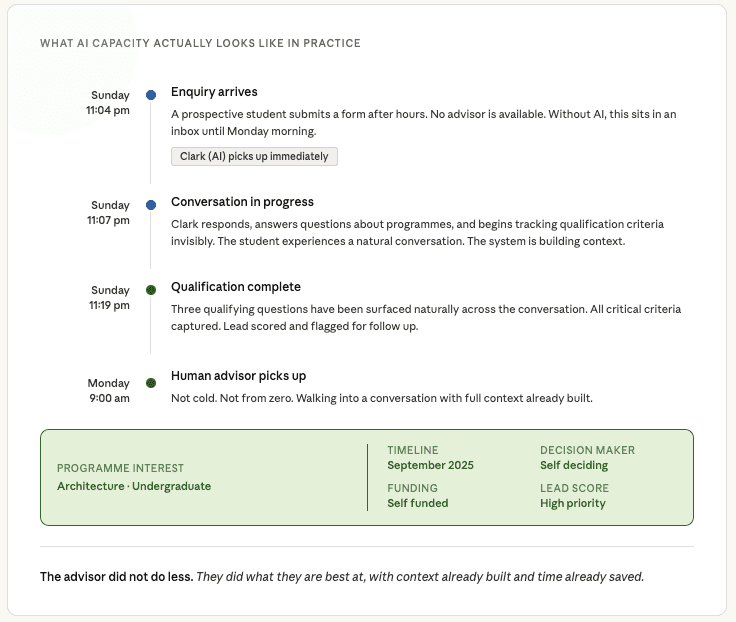
Parent messages at midnight asking about tuition payment plans. The system doesn't log it for morning review. It reads the message, understands the actual concern (they're worried about affordability but don't want to seem like they can't pay), provides options that address both the stated question and the underlying anxiety, schedules a follow-up call at a time that works for them, and sets reminders if they don't respond.
When your admissions team arrives in the morning, they're not sorting through 40 raw inquiries. They're reviewing 8 conversations where the system already handled qualification and flagged the ones that genuinely need human expertise.
You can now encode expertise without spending millions on custom software. Take your best performer, document how they think through decisions, structure it as executable logic, deploy it. When you buy the next business, you roll out the same capability in a week.
General Catalyst figured this out three years ago. They've deployed billions across ten different companies. Long Lake bought 18 businesses and drove productivity up 25-30% across their HOA management portfolio. Not by working people harder. By giving them systems that absorb routine work so they can focus on complex problems. Their customer pipeline increased 10x because sales reps could suddenly handle way more prospects.
Crescendo took call center margins from industry standard to 60-65%. Same service, completely different economics.
They're operating companies with software margins built on service business foundations.
Why MENA Specifically
MENA service businesses have three characteristics that make them better targets than US equivalents.
Most run on WhatsApp and Excel. Over 90% of enterprises are SMEs. Sub-$10M businesses have zero process documentation. Everything lives in people's heads. There's no legacy software to rip out, no existing contracts to unwind, no employees trained on old systems who'll resist change. You can go straight from manual operations to AI-native deployment.
US service businesses spent the last decade getting colonized by vertical SaaS. Now they're stuck with technical debt and change management problems. MENA skipped that entire phase.
The labor economics shifted. The talent pool that made Gulf service businesses attractive isn't infinite anymore. Salaries are rising. Nationalization requirements are creating hiring constraints. The old arbitrage based on cheap labor is dead.
AI creates different arbitrage. Your customer service team that handled 200 daily inquiries now handles 600. Same people. They're just working on interactions that actually need human judgment instead of typing the same responses for the hundredth time.
Capital is flooding in. Saudi Arabia's share of regional PE deals jumped from 20% to 41% in three years. Nearly 80% of Middle Eastern LPs are increasing their PE allocations. Vision 2030 initiatives. 100% foreign ownership in UAE. Government AI programs across the Gulf.
But the businesses getting this capital are operationally primitive. That's not a problem. That's the opportunity.
The Math
Take a typical MENA service business doing $42M in revenue with 12% EBITDA margins. That's $5M in EBITDA. It trades at 5x, so you pay $25M.
Right now, that business is spending roughly $200K annually on software. CRM to track customers. Scheduling tools. Communication platforms. Analytics dashboards. Each charges per seat, per month. As the team grows, software costs grow proportionally.
Here's what changes when you deploy agentic AI systems.
You replace that entire software stack with AI agents that don't just store information or route tasks. They execute complete workflows autonomously. Customer inquiry comes in, the system qualifies the lead, provides information, schedules follow-up, handles the entire interaction. No human touches it unless it genuinely needs judgment.
The cost? Around $150K annually after initial deployment. That's $50K saved on software alone.
But that's not where the real money is.
The same team that was handling 200 customer inquiries per day now handles 600. Because 70% of inquiries never reach them. The AI handles qualification, scheduling, routine questions, and follow-up. Your team only sees the 30% that actually need human expertise.
That's 3x capacity expansion with zero new headcount.
Let's make this concrete. Say your customer service team costs $1.2M annually in salaries (10 people at $120K all-in). Before AI, they could handle enough volume to support $42M in revenue. After AI, that same team can support $126M in revenue because their capacity tripled.
You're not firing anyone. You're growing revenue without proportionally growing the team.
On a $42M revenue base, here's what that looks like:
Before AI:
Revenue: $42M
Team capacity: 10 people handling 200 daily interactions
EBITDA margin: 12%
EBITDA: $5M
After AI (same revenue, transformed operations):
Revenue: $42M (unchanged)
Team capacity: Same 10 people now handling 600 daily interactions
Software costs: Down $50K
Operational efficiency: Massive excess capacity
EBITDA margin: 35%
EBITDA: $14.7M
The margin expansion comes from radically better labor leverage. You're getting 3x the output from the same cost base.
Now add growth. That team with 3x capacity can support way more clients. The business that was at capacity with 200 clients can now handle 600 without opening new locations or hiring proportionally.
Even modest 20% annual growth on that transformed base changes everything:
Year 1: $42M → $50M revenue, still at 35% margins = $17.5M EBITDA
Year 2: $50M → $60M revenue, 35% margins = $21M EBITDA
Exit at 8x EBITDA on $21M gets you $168M.
That's 6.7x return in 36 months.
And this is conservative. We're assuming you only grow 20% annually when you've just tripled your team's capacity.
Why Funds Haven't Done This
Most PE funds are still trying to figure out if AI is ready. That's the wrong question. AI works right now.
The right question is: what just became aggregable that wasn't before?
Service businesses. You can deploy identical operational capabilities across 20 acquisitions and get consistent margin improvement. At that point you're not buying individual businesses. You're building a platform.
MENA funds are still evaluating. The pricing gap is compressing in real time. Within 18 months, every PE fund will understand this. The easy acquisitions will be gone. Entry multiples will have adjusted.
What Works
Not every service business is a good target. You need high recurrence revenue, relatively homogenous operations, fragmented competition, and light regulatory complexity. Education works. Professional services work. Facilities management. Specialized consulting.
The real advantage comes from doing it repeatedly. After 10-15 deployments, you know exactly which workflows drive the highest margin lift. Which service categories respond best. How to structure acquisitions for fast integration.
That knowledge compounds. It becomes the moat. Not the AI technology anyone can license, but knowing precisely where and how to deploy it profitably.