Universities Are Losing 91% of Their Prospective Students. Voice Agents Fix the Point Where They Drop Off
The average university converts 9% of inquiries into enrolled students. Not 9% of random website visitors. 9% of people who actively raised their hand and said "I'm interested."
Ninety-one out of every hundred prospective students who fill out an inquiry form, request a brochure, or message admissions on WhatsApp never enroll. Most of them don't get rejected. They just never hear back fast enough.
The typical admissions office takes 42 hours to respond to an inquiry. By then, 78% of students have already committed to the first institution that responded. That isn't a branding problem. That isn't a curriculum problem. It's a speed problem with a very specific dollar value attached to it.
Universities know this. They've known it for years. They still can't fix it because the fix was always "hire more people," and the economics of hiring more admissions staff stopped working a long time ago.
Something changed in the last 12 months. Voice AI got good enough to handle the exact conversations that admissions teams can't get to in time. Not scripted auto-dialers. Actual voice agents that call prospective students, understand context from their inquiry, address their specific concerns, and move them through the enrollment funnel before a human ever picks up the phone.
We're building these systems for education institutions across the Gulf. Here's what's actually happening.
The Admissions Bottleneck Nobody Solved
Every university's enrollment funnel follows the same pattern: Inquiry → Lead → Application → Admitted → Enrolled. At each stage, students fall off.
The biggest drop happens between inquiry and application. A student submits a form at 11 PM asking about tuition for a business program. The admissions team sees it at 8:30 AM the next day, buried under 39 other inquiries that came in overnight. They respond sometime before lunch, maybe. By then, the student has already Googled three other universities, filled out two more forms, and gotten an instant WhatsApp reply from a competitor.
The data backs this up consistently. Responding within 5 minutes makes an institution 21 times more likely to qualify that lead than waiting 30 minutes. After 5 minutes, the odds of qualifying an inquiry drop by 80%. Yet the average response time across education institutions is measured in days, not minutes.
This isn't because admissions teams are lazy. It's because the math is physically impossible.
A mid-sized university might receive 300-500 inquiries per month during peak enrollment season. Each prospective student needs 15-20 touchpoints across months before enrolling. That's 6,000-10,000 individual interactions that need to happen. A team of 8-10 admissions counselors, also running campus tours, reviewing applications, sitting in committee meetings, and handling parent calls, cannot generate that volume of personalized outreach.
The result is predictable. High-intent leads get generic email sequences. Follow-ups happen when someone remembers, not when the student is actually available. Phone calls go to voicemail because they're placed at 10 AM on a Tuesday when the student is in class, not at 6 PM when they're free. Seventy percent of inquiries never receive a direct human response within 24 hours.
Meanwhile, admissions offices are experiencing 50% annual turnover. Two-thirds of staff report burnout. The repetitive nature of answering the same questions for the hundredth time — "What's the application deadline?" "Do you offer payment plans?" "What are the entry requirements for engineering?" — drives talented people out of the profession.
Universities tried fixing this with CRM workflows. Automated email drip campaigns that fire on schedule regardless of context. If the student opened email 3, send email 4 after 72 hours. If they clicked a program page, trigger a "We noticed you're interested in..." message.
The problem: email open rates in education marketing hover around 20%. Students don't read them. They skim, maybe. They certainly don't feel contacted. And the moment a student's situation diverges from the pre-built workflow — they have a specific financial concern, they're comparing two programs, they need to know if credits transfer from another institution — the automation fails silently and the student gets another generic message that makes them feel like a number.
Universities don't have a demand problem. They have a conversion problem. The students are already in the funnel. The institution just can't physically get to them fast enough with the right information.
What Voice Agents Actually Do
Here's the system architecture we've built. It's two products working together: an AI chatbot handling inbound conversations across web and WhatsApp, and a voice agent making proactive outbound calls.
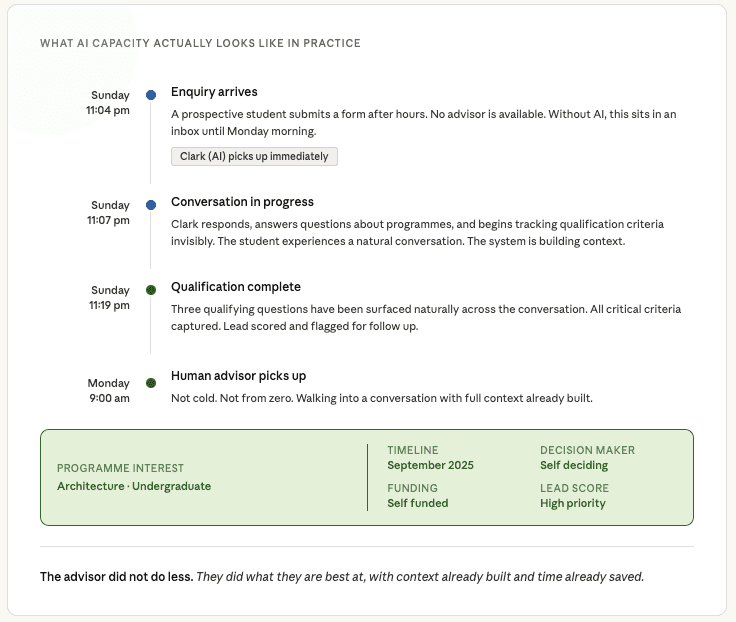
A student fills out an inquiry form on a university's website at 11 PM. Within seconds, the chatbot sends a personalized WhatsApp message. Not "Thank you for your inquiry, a counselor will contact you within 2 business days." An actual conversation. It knows the student asked about a specific program. It knows the tuition range. It asks what questions they have right now. If the student responds — and they do respond, because it's WhatsApp and it's instant — the system handles qualification in real time.
The next morning, the system doesn't just dump a lead into a spreadsheet for the admissions team to call. It already knows the student's interest level, specific concerns, program preferences, and availability. It generates a call brief and schedules a voice agent call for a time when the student is most likely to pick up.
The voice agent calls. This is the part people don't believe until they hear it. It's not an IVR menu. It's not "Press 1 for admissions." It's a natural conversation that references the student's actual inquiry.
"Hi, is this Sarah? I'm calling from the admissions team. I saw you were looking into the digital media program and had some questions about tuition. I wanted to make sure you got everything you needed about costs and the application timeline."
If Sarah says she's worried about affording the program, the voice agent doesn't read a script about scholarships. It acknowledges the concern, provides specific payment plan options relevant to her situation, and offers to schedule a call with a financial aid counselor. If she mentions she's also considering another university, the agent addresses it. If she wants to schedule a campus visit, it books one right there.
After the call, the system generates a summary: what was discussed, the student's intent level, blockers to enrollment, and recommended next steps. It updates the lead score dynamically. A student who picked up, asked detailed program questions, and wants to visit campus gets a different score than one who didn't answer. That score feeds back into the admissions dashboard, so human counselors know exactly where to spend their time.
The technical architecture underneath this isn't trivial. The voice agent has to plan before it calls. It reviews the student's complete interaction history — what they asked the chatbot, which program pages they visited, what forms they filled out — and builds a qualification strategy before dialing. It identifies the most likely objections and prepares responses. This isn't a random "checking in" call. It's a structured conversation with a specific goal: move the student to the next stage of the funnel, or identify that they're not a fit and save the admissions team from wasting time.
The personality layer matters more than most people expect. An 18-year-old prospective undergraduate responds differently than a 35-year-old professional seeking an MBA. A parent calling about their child's options has different emotional drivers than the student themselves. The system adapts its communication style, information density, and conversational approach based on who it's talking to.
The Numbers
Let's run the economics on a mid-sized university in the Gulf with 5,000 inquiries per year.
Current state (no AI, typical admissions team):
Inquiries: 5,000/year
Average response time: 24-42 hours
Inquiry-to-application rate: 25% (1,250 applications)
Application-to-enrollment rate: 30% (375 enrolled students)
Overall conversion: 7.5%
Cost per inquiry (marketing): $50
Total marketing spend: $250,000
Cost per enrolled student: $667
After deploying voice + chat agents:
Same 5,000 inquiries
Average response time: under 2 minutes (chat) + proactive voice follow-up within 24 hours
Inquiry-to-application rate: 35% (1,750 applications — a 40% improvement driven entirely by faster, personalized engagement)
Application-to-enrollment rate: 33% (578 enrolled students)
Overall conversion: 11.6%
Same marketing spend: $250,000
Cost per enrolled student: $432
That's 203 additional enrolled students from the same marketing budget. Zero additional ad spend.
At an average tuition of $15,000 per year in the Gulf's private education sector, those 203 students represent $3.05M in first-year revenue. Over a 3-4 year degree program, that's $9-12M in additional lifetime revenue.
The AI system costs roughly $100-150K annually to operate. That's a 20-30x return on the technology investment in the first year alone.
But the capacity shift is where this gets interesting.
The admissions team of 10 people was previously spending 60-70% of their time on routine outreach: initial contact calls, answering repetitive questions, chasing documents, sending reminders. The voice and chat agents absorb that entire workload.
Those same 10 people now spend 90% of their time on high-value activities: in-depth counseling sessions with serious applicants, campus tours, complex cases involving transfer credits or special accommodations, and relationship-building with high-intent prospects. They're not working harder. They're working on interactions that actually require human judgment.
When the university decides to grow — launch a new program, expand into a new market, increase intake targets by 30% — they don't need to proportionally grow the admissions team. The AI agents scale with volume. The humans handle the same percentage of complex interactions. The team that supported 5,000 inquiries can support 15,000 without adding headcount.
Why the Gulf Education Market Specifically
The MENA higher education market is on a trajectory toward $175 billion by 2027. The UAE alone saw 57,035 new students enrolled in 2024-25, a 13% year-over-year increase and the highest number in a decade. Dubai's international student enrollment jumped 29% in a single year. Saudi Arabia needs to create 900,000 additional university places by 2030.
But here's what makes these institutions better candidates for voice AI than their US or UK counterparts.
The infrastructure gap works in your favor.
Most Gulf universities run admissions on a combination of Excel, email, and WhatsApp. Some have a CRM. Few use it properly. There's no legacy automation to rip out. No multi-year Salesforce contracts to unwind. No staff trained on systems they'll resist replacing. You go straight from manual outreach to AI-native operations in a week.
The multilingual reality demands it.
A university in Dubai serves students from 100+ nationalities. Parents communicate in Arabic, Hindi, Urdu, English, and Tagalog. An admissions counselor who speaks three languages is exceptional. A voice agent that handles all of them is table stakes. The student who submits an inquiry in Arabic at midnight and receives an Arabic voice call the next morning isn't getting a "better experience." They're getting a response that was physically impossible before.
The competition for international students is existential.
UAE universities are competing directly with institutions in the UK, Australia, Canada, and increasingly with Saudi Arabia's new wave of branch campuses. Gulf students who used to go to the US are staying regional — Saudi students in the US dropped from 61,000 to 16,000 in eight years. The pool of regional students is growing, but so is the competition for them. Speed of response becomes a genuine competitive advantage when students are comparing five institutions across three countries simultaneously.
Enrollment seasonality creates impossible staffing math.
Gulf universities have multiple intake periods. Peak season means 3-4x normal inquiry volume over 6-8 weeks. You can't hire temporary admissions staff who understand your programs deeply enough to have meaningful conversations with prospective students. You can't scale a human team up and down four times a year. A voice agent handles 50 calls or 500 calls with the same quality, with no ramp-up time.
What Changes for Education Groups
A single university deploying voice agents improves its own conversion rates. That's useful. But the compounding effect kicks in when you operate multiple institutions.
Education groups running 3-5 campuses deploy the same AI system across all of them. The voice agent learns from every conversation it has — not just the script, but the patterns. Which objections come up most for business programs versus engineering. How pricing sensitivity differs between undergraduate parents and graduate professionals. What questions predict high enrollment probability.
After a few thousand calls, the system knows which students will actually enroll with startling accuracy. It adjusts its approach. Students who are comparison-shopping get different treatment than students who are ready to apply but need one question answered. The score updates after every interaction — chatbot, voice call, email open, campus visit — giving the admissions team a real-time signal of where each student sits in their decision.
This intelligence doesn't stay locked in one campus. The system that works for a media university in Dubai provides baseline patterns that accelerate deployment at a business school in Riyadh or a technical institute in Abu Dhabi. The second deployment takes days, not months.
The Gulf is full of exactly these institutions. They're growing, competing for a rapidly expanding international student population, running admissions operations built for half their current volume, and losing students to competitors who simply respond faster.
Blog